
June 11, 2026
Why court-approved Bates formats must be immutable for 2026 productions
To meet modern evidentiary standards, a Bates stamp is more than just a number on a page; it’s a permanent, non-negotiable anchor for a document's identity in the record. In 2026, courts increasingly
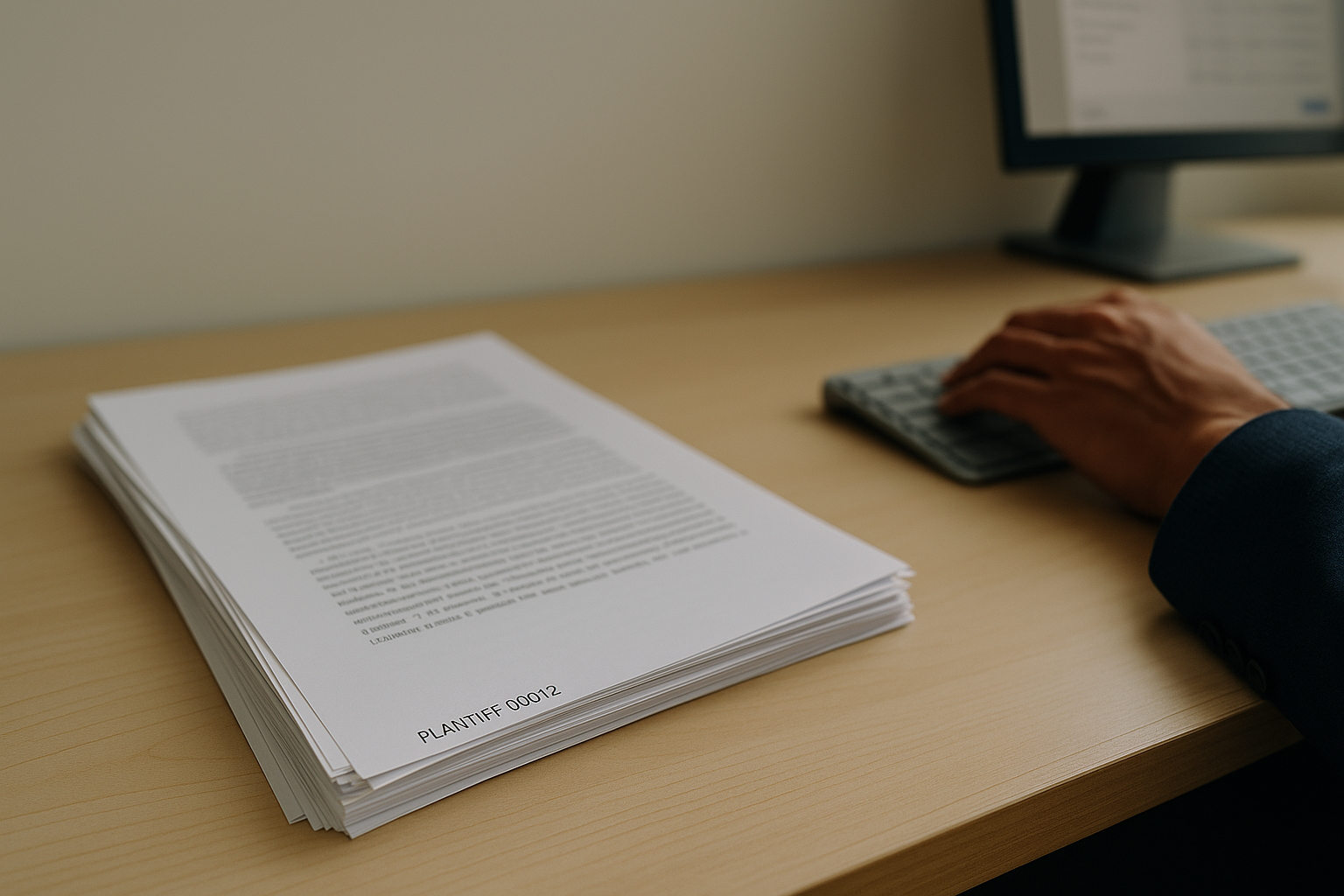
To meet modern evidentiary standards, a Bates stamp is more than just a number on a page; it’s a permanent, non-negotiable anchor for a document's identity in the record. In 2026, courts increasingly scrutinize production integrity, meaning any ambiguity in labeling—like shifting fonts, overlapping text, or missing sequential logs—can lead to challenges during deposition or trial. Achieving an audit-ready production requires stamping software that processes files locally to maintain metadata integrity while generating a definitive run log for every single page in the set.
Why court-approved Bates formats must be immutable for 2026 productions
A common mistake in discovery is treating Bates numbering as a cosmetic task rather than a legal requirement. When you apply a label to a PDF, you aren't just adding a footer; you're creating a unique identifier that will be referenced in motions, transcripts, and judicial orders for years to come. If that number is obscured by a messy scan or truncated because of a software glitch, the document's link to the production set is broken.
The technical requirements of a court-ready stamp
Most judges won't specify a font size or hex code for your labels, but they do expect consistency and legibility. If your production contains some pages with 12pt Arial and others with 8pt Calibri, it signals a lack of professional oversight. Worse, if the numbering skips or repeats—a frequent byproduct of manual entry—you risk a motion to compel or sanctions for a deficient production.
Reliable Bates labeling software must handle:
- Bates-sequential numbering that accounts for every file in the batch without human intervention.
- Court-approved formats that place the label in a consistent 'safe zone,' ensuring no vital document text is covered.
- High-resolution rendering so the stamp remains legible even when printed or viewed on low-resolution courtroom monitors.
Local processing vs. cloud-based security risks
In 2026, the safest way to process discovery is within your own environment. Moving sensitive, unproduced evidence to a third-party server just to add a number is an unnecessary risk. Modern web technologies allow for production-scale processing directly in your browser. This means the documents stay on your device, and the processing power of your local machine handles the heavy lifting. This architecture is the only way to guarantee that a client's confidential data never touches an external server before it is officially produced to opposing counsel.
| Feature | Professional Stamping (OmniBates) | Manual / Basic PDF Tools |
|---|---|---|
| Processing Location | Local (Your Device) | Often Cloud-hosted or Server-side |
| Sequential Logic | Automated Across Multiple Files | Single File Only / Manual Tracking |
| Audit Trail | Automatic Run Logs | None / Manual Log Spreadsheets |
| Capacity | Production-scale (Thousands of Pages) | Limited to small batches |
| Formatting | Fixed Court-approved Templates | Variable / Error-prone |
Why audit-ready run logs are your best defense
If opposing counsel claims you withheld documents or modified a set post-production, your only defense is the run log. A run log is a technical manifest of a production. It lists every original filename alongside its corresponding Bates range.
We built OmniBates to generate these logs automatically. It’s a simple spreadsheet, but it’s the 'black box' for your production. It proves exactly what went in and exactly what came out. Without this, you're left manually cross-referencing filenames against page counts—a process that loses billable hours and invites human error. In 2026, an audit-ready log is the difference between a smooth discovery phase and a multi-day forensic dispute over production gaps.
Handling same-day productions with mixed file types
Litigation doesn't wait for your software to finish 'uploading' five gigabytes of PDFs. Same-day productions require a tool that can ingest mixed formats—scans, native exports, and cleaned PDFs—and apply Bates-sequential numbering instantly. Because local processing eliminates the 'upload/download' bottleneck, you can process thousands of pages in minutes.
Accuracy is the priority, but speed is the reality. When a partner asks for a production by 5:00 PM, you can't afford a 'processing' spinner on a cloud website. You need software that works at the speed of your local hardware.
Common pitfalls in document labeling
- Overlapping Text: Using tools that don't allow for custom margins leads to stamps covering signatures or dates.
- Broken Sequences: Manually restarting a sequence for a second batch often leads to 'Bates-001' existing in two different folders.
- Metadata Stripping: Some cloud converters strip original metadata during the stamping process. Local processing helps preserve the file's integrity.
- No Alpha-Prefix: Not including a consistent prefix (e.g., PLTF-0001) makes document searching efficient in large databases impossible.
FAQ
Do documents leave my computer when using OmniBates?
No. We designed the application to process everything locally. Your files stay on your device, which is essential for maintaining confidentiality and complying with data privacy regulations in 2026.
What is an 'audit-ready run log'?
An audit-ready run log is a detailed report generated at the end of the stamping process. It maps the original filename to the assigned Bates numbers, providing a verifiable trail that ensures no documents were skipped or misnumbered during the production.
Can it handle production-scale batches?
Yes. The software is built for high-volume litigation support workflows. By utilizing local processing power, it can handle thousands of pages for same-day productions without the lag associated with cloud-based tools.
Why is Bates labeling better than just naming the file?
Courts require a persistent identifier on the page itself. If a single page is pulled from a 100-page file, the Bates stamp ensures that specific page can still be identified and authenticated in court. Filenames can be changed; a burned-in Bates stamp is permanent.
Sources / Further reading: For more on federal discovery standards, refer to the Federal Rules of Civil Procedure (FRCP) Rule 34 regarding the production of documents and electronically stored information (ESI).