
June 12, 2026
Why court-approved Bates formats require more than just a PDF stamp.
A document production is only as strong as its weakest Bates label. If a stamp obscures a crucial signature, bleeds off the margin during a print job, or fails to embed correctly in a PDF, the product
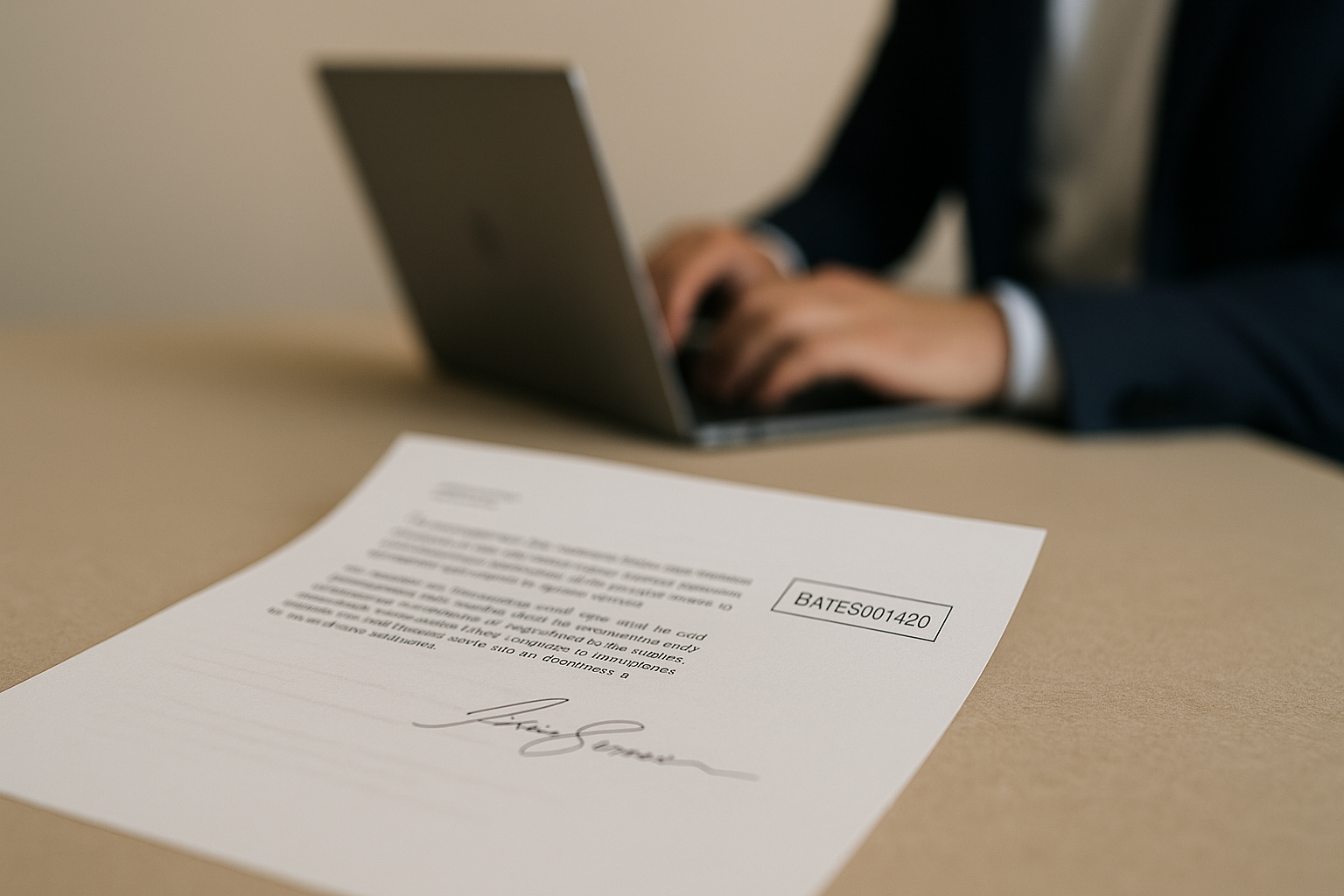
A document production is only as strong as its weakest Bates label. If a stamp obscures a crucial signature, bleeds off the margin during a print job, or fails to embed correctly in a PDF, the production is non-compliant. In 2026, court-approved formats demand a specific trifecta of legibility, persistence, and auditability that basic PDF annotators simply can't provide without significant manual intervention.
The technical gap in standard PDF stamping
Most practitioners realize too late that standard PDF 'stamps' are often just metadata layers. If those layers aren't properly flattened or if they interfere with the document's underlying OCR text, you risk rejection from opposing counsel or the court's e-filing system. True Bates labeling software, like OmniBates, handles the heavy lifting of adjusting margins and ensuring the label is part of the document's permanent visual record without compromising the integrity of the original evidence.
Why local processing is the primary defense against data breaches
Security isn't just a checkbox; it's a technical architecture. The most common vulnerability in discovery workflows is the transfer of sensitive files to a third-party server. When you use cloud-based tools, your firm's most confidential evidence lives on someone else's hardware.
We built OmniBates around a local processing model. Your documents never leave your device. Your browser handles the Bates numbering locally, using your own machine's RAM and CPU. This eliminates the risk of interception and ensures that even if a vendor’s server is compromised, your client's data remains untouched on your local workstation. It's the only way to handle high-stakes litigation where confidentiality is non-negotiable.
Benchmarking production-scale document processing
When a production scales from fifty pages to fifty thousand, the margin for error disappears. Small firms and boutique litigation shops often struggle with the 'stutter' of web applications that try to upload and download every single page. A local-first approach provides a massive speed advantage because there's no bandwidth bottleneck.
| Feature | Generic PDF Stamper | OmniBates Workflow |
|---|---|---|
| Data Residency | Hosted on cloud servers | Stays on your local device |
| Processing Speed | Limited by upload speed | Limited by local hardware |
| Auditability | Rarely provides logs | Automated, audit-ready run logs |
| Compliance | Mixed/Manual margins | Built-in court-approved formats |
| Sequential Logic | Manual re-entry | Automated Bates-sequential logic |
The necessity of audit-ready run logs
If the court asks for an account of exactly when and how a production was numbered, a simple folder of PDFs isn't enough. You need an audit-ready run log. This log acts as the definitive map of your production, linking original filenames to their assigned Bates ranges.
In a complex discovery dispute, these logs are your shield. They prove the consistency of your numbering sequence and provide a clear trail of the production's history. Without an automated log, your team spends billable hours manually cross-referencing spreadsheets—a task that is ripe for human error.
Three pillars of a court-ready production
- Legibility across devices: Labels must be readable whether viewed on a tablet in a deposition or printed out for a trial binder. This means choosing high-contrast, professional fonts that are embedded directly into the file.
- Margin Integrity: A label should never cover a date, a signature, or a footnote. Sophisticated tools allow for 'shrink-to-fit' logic that ensures the Bates stamp has its own dedicated real estate on the page.
- Bates-Sequential Integrity: Gaps in numbering are the fastest way to trigger a motion for sanctions or a grueling meet-and-confer session. Automated sequential numbering handles the math so your paralegals don't have to.
Stop losing billable hours to manual Bates labeling. By moving your production-scale processing to a local-first environment, you protect your data while meeting the most rigorous standards of litigation support.
Does OmniBates work with scanned PDFs and OCR text?
Yes. OmniBates is designed to handle various discovery formats, including scans and PDFs. Because it processes files locally on your computer, it can stamp large, high-resolution scans without the lag or timeout issues common with cloud-based services.
Can I customize the Bates prefix and starting number?
Absolutely. The software allows for full customization of the prefix (e.g., SMITH_000001) and ensures that the sequence remains perfectly incremental across multiple files. This is essential for maintaining firm-standard compliance during same-day productions.
Is there a limit to how many pages I can process at once?
Because the processing happens in your browser on your own hardware, the limit is typically determined by your computer's resources. OmniBates is built for production-scale processing, meaning it can handle thousands of pages in a single run without the document ever leaving your device.
What formats are considered "court-approved" in 2026?
While specific requirements vary by district, the general standard is a clear, legible, and unique alphanumeric identifier placed in a consistent location (usually the bottom right) that does not obscure document content. OmniBates uses these industry-standard layouts by default.
How do I generate an audit log for my production?
OmniBates automatically generates audit-ready run logs during the processing phase. These logs provide a detailed record of the files processed and the Bates ranges assigned, which can be saved alongside your production for future reference or court verification.
Sources / Further reading: For more on the risks of cloud-based discovery, see recent security guidelines regarding data residency and legal tech compliance.